
peter @aimyskin.com
+86-18031361872
- All
- Product Name
- Product Keyword
- Product Model
- Product Summary
- Product Description
- Multi Field Search
Views: 141 Author: Site Editor Publish Time: 2026-08-14 Origin: Site


Moving aesthetic consultations outside a controlled clinical environment introduces unpredictable variables. You often face poor ambient lighting, limited setup time, and tight spatial constraints. Mobile practitioners desperately need clinical-grade diagnostic accuracy without dragging around the bulk of a standard desktop machine. Relying on basic magnifying lamps or generic smartphone apps quickly degrades your perceived authority. It also severely compromises your diagnostic credibility. Clients expect a premium, scientific experience regardless of the physical location. We offer a proven framework for evaluating the ideal diagnostic device to fit your unique mobile workflow. You will learn how to properly assess various form factors, essential hardware specifications, and secure software ecosystems. We will also guide you on sourcing smart to elevate your traveling practice and secure client trust seamlessly.
Design Trade-offs: The choice between handheld wands, tablet-integrated devices, and compact foldable units dictates the balance between ultimate mobility and diagnostic depth.
Critical Specs: Not all portable units isolate ambient light effectively. Multi-spectral imaging (RGB, UV, PL) and enclosed hoods are mandatory for consistent mobile assessments.
Data Portability: Cloud-sync capabilities allow mobile practitioners to capture data on-site and finalize treatment plans seamlessly across different devices or clinic locations.
Sourcing Smart: Partnering with a vetted portable skin analyzer supplier ensures access to reliable warranties, compliance standards, and white-label customization for brand consistency.
Standard clinical analyzers require dedicated operational space. They need highly stable power sources and strictly controlled room lighting to function properly. Mobile pop-up clinics, VIP home visits, and traveling educators completely lack these environmental guarantees. You cannot control the harsh fluorescent lights of an exhibition hall. You cannot dictate the dim, warm ambiance of a luxury hotel suite. This unpredictability creates a massive diagnostic challenge.
To overcome these hurdles, a mobile consultations portable skin analyzer must meet specific operational benchmarks. If the device fails any of these core criteria, it becomes a liability rather than a sales tool.
Rapid Deployment: Setup and boot time must fall under three minutes. Mobile practitioners operate on strict schedules. You cannot waste valuable consultation minutes waiting for complex software to calibrate.
Environmental Isolation: Hardware design must actively block out variable ambient light. Bright environments wash out surface texture readings. Dim rooms force cameras to overcompensate, skewing pigmentation baselines. Total light isolation guarantees consistent imaging.
Trust Generation: The device must look highly professional and clinical. You charge premium consultation fees for out-of-clinic services. A high-tech, medical-grade aesthetic immediately justifies those rates to your clients.
Many practitioners assume a tablet camera provides enough detail for a baseline assessment. This is a critical error. Tablet cameras auto-adjust white balance based on the room. This makes accurate before-and-after tracking entirely impossible when the client returns for a follow-up visit under different lighting conditions.
Every mobile device requires compromises. Understanding the solution categories helps you balance ultimate mobility against necessary diagnostic depth. We evaluate three primary form factors dominant in the current aesthetic market.
These ultra-compact devices represent the most basic entry point into mobile diagnostics. They often clip onto an existing mobile phone or function as standalone pens.
Pros: They offer ultimate portability. They fit easily into a pocket or small travel bag. They generally represent the lowest upfront cost.
Cons: They remain highly susceptible to ambient light interference. They rely entirely on your hand stability to maintain a consistent focal length. They completely lack full-face mapping capabilities.
Best Practice: Reserve handheld wands exclusively for localized spot-checking. They work exceptionally well for scalp evaluations or isolating specific vascular lesions, but they fail at comprehensive facial mapping.
These devices combine a camera, specialized lighting, and a screen into a single cohesive unit. You interact directly with the hardware casing.
Pros: They deliver an excellent client presentation experience. You can easily hand the device directly to the client for review. The self-contained nature eliminates the need for extra cables.
Cons: Battery drain presents a massive challenge. Running high-resolution touch screens alongside intense multi-spectral flashes depletes batteries rapidly. They also carry a medium weight, making them slightly heavier for prolonged handheld use.
These units shrink the standard clinical dome into a foldable, highly transportable format. They usually require an external tablet or laptop to run the software interface.
Pros: They deliver the highest diagnostic accuracy available on the road. They provide clinical-grade light isolation through physical hoods. They successfully execute true full-face analysis.
Cons: They strictly require a stable tabletop for operation. They are heavier and bulkier to transport. The reliance on an external screen adds a step to the setup process.
Form Factor | Light Isolation | Full-Face Mapping | Ideal Mobile Scenario |
|---|---|---|---|
Handheld Wands | Poor | No | Scalp checks, isolated lesions |
Tablet-Integrated | Moderate | Partial / Guided | VIP home visits, quick pop-ups |
Foldable Hoods | Excellent | Yes | Trade shows, mobile clinics (table required) |
Form factor dictates usability, but internal hardware dictates clinical accuracy. You must scrutinize exact portable skin analyzer specifications to ensure the device performs under pressure. Features must translate directly into reliable clinical outcomes.
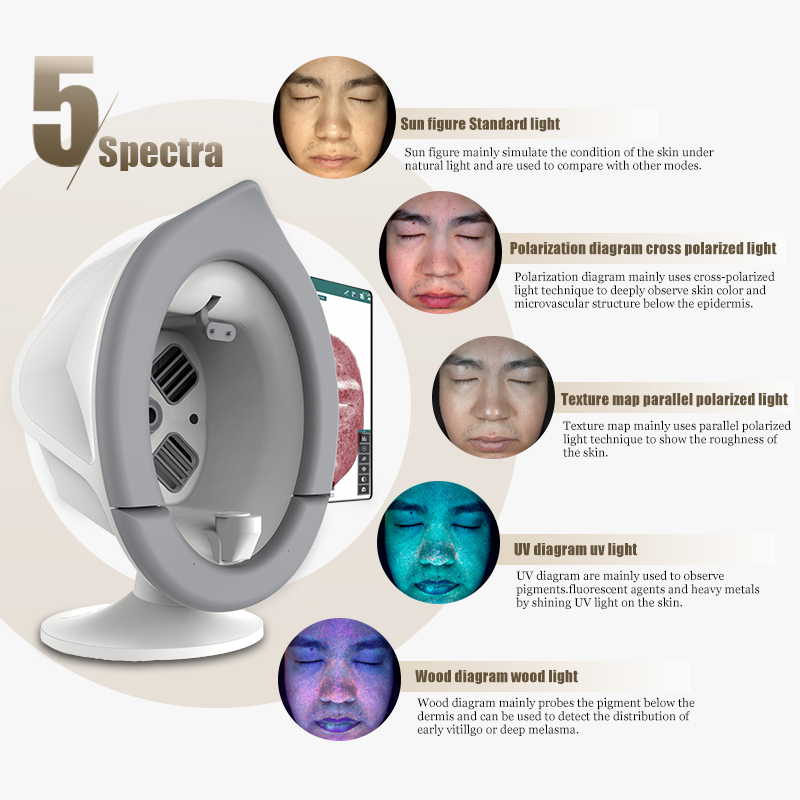
A standard visible light photograph provides zero diagnostic value beyond what the naked eye sees. Your device needs a minimum of three distinct spectrums to justify its clinical role.
RGB (Visible Light): Captures surface textures, visible pores, and current wrinkle depth.
UV (Ultraviolet): Penetrates deeper to reveal hidden porphyrins (acne-causing bacteria) and underlying sun damage invisible to the naked eye.
PL (Polarized Light): Strips away surface reflections to expose vascular conditions, rosacea, and deep pigmentation clustering.
The portable battery must support consistent flash intensity across all spectrums. If a low battery causes the UV flash to dim, the resulting image will falsely suggest a reduction in sun damage.
Diagnostic imaging demands high resolution. Look for a minimum sensor capacity of 15 to 20 megapixels. This density ensures you can zoom into specific facial zones without pixelation. Furthermore, optical zoom capabilities heavily outweigh digital zoom. Digital zoom simply crops and stretches an image, destroying crucial diagnostic integrity. Optical zoom physically adjusts the lens, maintaining absolute clarity in mobile environments.
A dead device mid-consultation destroys client trust instantly. When evaluating batteries, strictly differentiate between continuous operation time and standby time. A device might boast 12 hours of standby time but only manage 90 minutes of continuous scanning.
Ensure the device supports standard USB-C PD (Power Delivery). This allows you to use generic high-capacity power banks in an emergency. Alternatively, seek units offering hot-swappable interchangeable battery packs. This design prevents downtime completely during high-volume trade shows.
Mobile equipment takes a physical beating. Trunk transit, accidental drops, and baggage handlers introduce severe risk. Request official drop-resistance ratings from the manufacturer. Evaluate the specialized travel casing carefully. Flight-ready, foam-lined hard cases provide necessary protection. Flimsy soft bags will inevitably lead to broken internal mirrors or cracked lenses.
Hardware captures the image, but software monetizes the consultation. Mobile environments demand highly robust, scalable, and secure software ecosystems. A beautifully designed portable skin analyzer means nothing if it cannot process or secure data efficiently in the field.
Wi-Fi connections at trade shows drop constantly. Cellular data in luxury hotel basements often disappears entirely. Can the device capture and store scans locally when the network fails? Top-tier mobile software relies on local caching. It stores the heavy image files directly on the device memory. It runs the diagnostic algorithms locally. This ensures your workflow never stalls, even in complete digital isolation.
Once you step back into a stable Wi-Fi zone, the local storage must sync seamlessly. Evaluate how the device pushes local data to your central CRM. This automated cloud architecture proves essential for multi-location businesses. A traveling aesthetic team can capture a client profile in one city, and a separate clinic location can access those identical treatment plans the next day.
Mobile devices carry an extremely high risk of being lost or stolen. Aesthetic scans qualify as sensitive medical or personal data under GDPR and HIPAA regulations. Evaluate the software for strict local encryption protocols. Ensure the device requires robust password protection or biometric logins. Most importantly, verify the presence of remote-wipe capabilities. If you leave a tablet in a taxi, you must retain the power to instantly delete all local client records from a remote browser.
Your relationship with the manufacturer matters just as much as the device itself. Implementation and vetting processes require careful attention. A reliable partner safeguards your operational continuity.
Building brand equity during mobile events requires a cohesive visual identity. Explore opportunities for a custom portable skin analyzer. Work closely with OEM/ODM suppliers to white-label the hardware casing. You can often match the device color to your brand guidelines. More importantly, request UI customization. Displaying your unique clinic logo on the software interface heavily boosts brand authority. It transforms a generic hardware piece into your proprietary diagnostic system.
Mobile devices suffer substantially higher wear-and-tear than desktop units. Standard 12-month clinic warranties rarely cover travel-induced damage. When evaluating a portable skin analyzer supplier, interrogate their repair logistics. Look for partners offering expedited hardware swaps. If your unit breaks on a Tuesday, you need a replacement shipped by Thursday. Prioritize suppliers who include ruggedized travel cases as standard rather than expensive add-ons.
Hardware represents only the initial investment. You must clarify the software fee structure before signing any purchase order. Does the supplier charge a one-time lifetime license for the software? Do they rely on recurring SaaS (Software as a Service) fees for cloud storage access? Ask specific questions about AI algorithm updates. As diagnostic AI improves, some suppliers push free over-the-air updates, while others charge heavy premium upgrade fees. Transparent ecosystem pricing prevents unexpected operational hurdles down the road.
Demand a live demonstration of the offline-sync capabilities.
Request detailed documentation on drop-test ratings.
Review the explicit terms regarding expedited replacement shipping.
Clarify data hosting locations for local privacy compliance.
The right design bridges the difficult gap between strict mobility constraints and mandatory clinical accuracy. Moving outside your clinic no longer requires sacrificing diagnostic integrity. You simply need to align your hardware choice with your specific workflow reality.
Choose handheld wands strictly for localized or scalp analysis where deep facial mapping is unnecessary. Opt for tablet-integrated units when conducting VIP home visits where client presentation speed is paramount. Rely on compact foldable hoods for professional pop-up clinics where a stable tabletop is readily available and maximum diagnostic depth is expected.
Your next step requires a clear audit of your standard mobile consultation environment. Document your typical lighting conditions, available space, and expected daily client volume. Reach out to shortlisted vendors and demand specific offline-capability demonstrations to ensure the device performs exactly when you need it most.
A: Yes, provided the portable unit utilizes a physical light-isolating hood and identical multi-spectral imaging sensors. Accuracy drops significantly only when mobile devices rely on open-air cameras. Open designs allow variable ambient light to alter image color calibration and skew AI results.
A: Most clinical-grade portable units support 3 to 5 hours of continuous operation per charge. This translates to roughly 40 to 60 full-face scans. Always look for devices supporting USB-C power delivery for easy emergency charging.
A: Top-tier devices allow local caching, creating an offline mode. You can capture and analyze images without Wi-Fi. The device seamlessly syncs this local data to client profiles on the cloud once an internet connection is re-established. Always verify this specific feature with your supplier.


