
Views: 0 Author: Site Editor Publish Time: 2026-07-30 Origin: Site


The business reality in modern aesthetics is clear. The market is flooded with devices claiming advanced artificial intelligence capabilities. However, the gap between a superficial photo app and clinical-grade diagnostic hardware remains massive. Purchasing the wrong unit often results in staff friction. It leads to inaccurate client consultations. Ultimately, it drives a negative return on your initial investment.
We created this guide to strip away confusing marketing jargon. It provides a rigorous, evidence-based evaluation framework. You will learn exactly how to select a system. You want hardware that drives both clinical accuracy and retail conversions. A reliable AI skin analyzer machine forms the backbone of a modern consultation process. By following this framework, you can elevate your practice, build immediate client trust, and streamline your product recommendations without second-guessing the technology.
Hardware establishes the physical requirements before you can even begin evaluating software claims. A smart algorithm cannot fix a blurry, poorly lit image. High-quality optical data is the foundation of accurate dermatological assessment.
Standard RGB lighting is fundamentally insufficient for clinical analysis. It only captures what the naked human eye can already see. You need specialized lighting to reveal subsurface conditions. Multi-spectrum capabilities separate professional tools from consumer gadgets.
When reviewing technical documents, look for three non-negotiable lighting modes. First, Cross-Polarized lighting suppresses surface glare. It reveals underlying vascular mapping, such as rosacea or micro-capillaries. Second, Parallel-Polarized lighting highlights surface textures. It maps fine lines, enlarged pores, and rough patches perfectly. Finally, UV lighting safely exposes subsurface pigmentation and porphyrins. Porphyrins indicate acne-causing bacterial activity deep within the pores.
Best practices suggest avoiding machines missing any of these three spectrums. Comprehensive multi-spectrum imaging guarantees your diagnostic reports reflect the complete truth about your client’s dermal health.
Many buyers fall for the megapixel myth. They assume higher megapixels automatically equal better scans. In reality, focal length consistency matters much more. Ambient light shielding also plays a critical role. The hood design must block out external room lighting completely.
Implementation reality proves this point daily. Devices sensitive to ambient room lighting yield inconsistent progress reports. If a scan taken on a sunny Tuesday looks vastly different from a scan taken on a cloudy Thursday, clients lose trust. Consistency relies heavily on color-calibration standards built into the lens and sensor array.
Focusing on these physical traits ensures you capture pristine data. Pristine data feeds the software engine correctly.
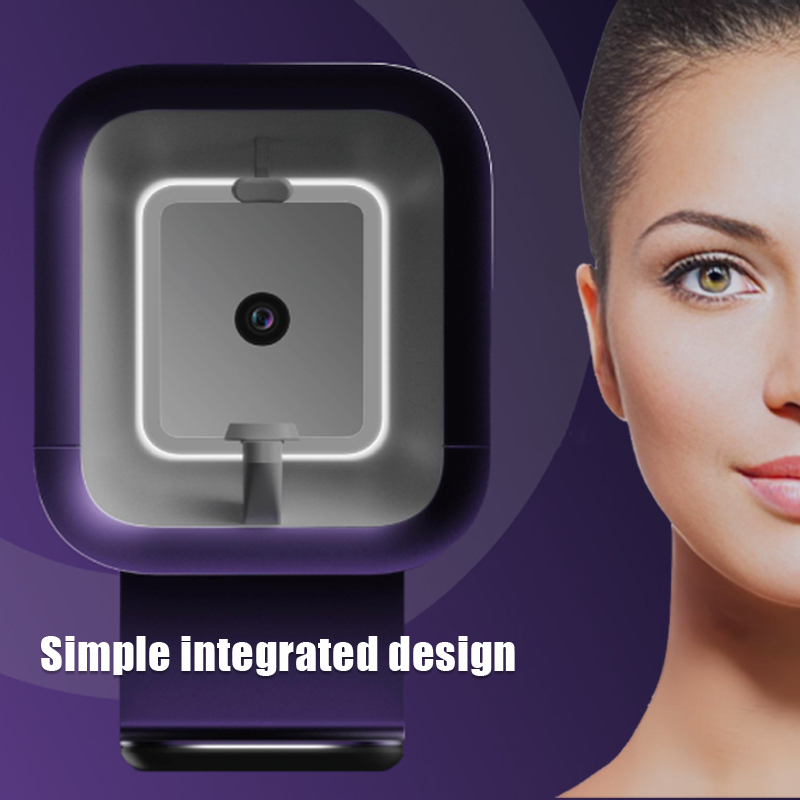
Once you secure excellent hardware, you must evaluate the machine learning components. You need to know how to interrogate the AI skin analyzer machine specifications related to its analytical brain.
A modern system must cover fundamental baseline requirements effortlessly. These include measuring hydration levels, sebum production, and porphyrin counts. It must accurately map wrinkles, surface pigmentation, and deep UV damage. These baseline metrics dictate standard facial treatments.
However, leading machines go much further. You should evaluate the presence of advanced dimensions. Sensitive skin detection helps prevent adverse reactions during chemical peels. Skin age calculations provide a highly motivating metric for patients. Dynamic progress tracking overlays let you visually merge a "before" and "after" scan. This feature proves treatment efficacy instantly.
Common mistakes occur when buyers accept vague "skin health scores." Always demand precise, quantified metrics for each individual dimension. A single aggregated score offers very little clinical value during a detailed consultation.
Algorithmic bias represents a massive hurdle in aesthetic technology. User-generated content and online forums frequently highlight common complaints. Many machines misdiagnose darker skin tones. They often confuse natural melanin distribution with UV damage or hyperpigmentation.
You must address this directly with the manufacturer. Ask them about their specific training dataset size. You also need to verify their Fitzpatrick scale inclusivity. Did they train the AI solely on Fitzpatrick types I-III? If so, the machine will fail miserably on types IV-VI.
Robust machine learning requires hundreds of thousands of diverse global scans. Only a diverse dataset ensures the algorithm scales accurately across varying ethnicities, ages, and genders. Insisting on this data prevents embarrassing consultation errors.
Technology must directly influence your bottom line. A standalone device slows down operations. A seamlessly connected beauty clinics AI skin analyzer machine transforms patient data into actionable sales workflows.
The bridge between diagnosis and retail sales requires intelligent software. Look for systems supporting automated, rule-based product recommendations. The machine should generate specific treatment suggestions based on strict diagnostic thresholds. If a client scores poorly on hydration, the system should instantly suggest your specific hyaluronic acid serum.
Success criteria depend heavily on customization. You must possess the ability to customize the recommendation engine. It should match your clinic's exact physical inventory. For example, you want to map a high UV damage score directly to your proprietary Vitamin C product. This automation removes the high-pressure sales burden from your aestheticians. The machine objectively tells the client what they need.
Assess cloud connectivity rigorously. A modern device must communicate with your existing ecosystem. Can the machine push client reports directly to your centralized CRM? You want API access to sync patient profiles automatically.
SDK availability opens up advanced mobile integrations. Your clinic app can directly receive the skin reports. Alternatively, look for native integrations pushing reports to WeChat or WhatsApp. Instant post-visit follow-ups keep clients engaged. They can review their 3D facial scans at home, increasing the likelihood of follow-up retail purchases.
Biometric data carries significant legal and reputational risks. Facial scans classify as highly sensitive personal information. You must mitigate these risks proactively through smart IT choices.
You must decide between edge computing and cloud-based analysis. Edge computing processes the images locally on the device itself. Cloud computing sends the images to a remote server for AI evaluation.
| Feature | Edge Computing (Local) | Cloud Computing |
|---|---|---|
| Processing Speed | Instant (Zero latency) | Requires fast internet connection |
| Data Security | Stays on local device entirely | Transferred over secure networks |
| Algorithm Updates | Requires manual software patches | Updates automatically on server |
| Storage Limits | Limited by internal hard drive | Virtually unlimited historical data |
Local processing offers immense privacy benefits. It eliminates network interception risks entirely. However, cloud processing usually provides more robust AI models. The cloud servers handle much heavier computational loads. Choose the architecture aligning best with your IT infrastructure.
You cannot ignore legal regulations regarding biometric data. Outline the necessity for GDPR compliance if you operate in or near Europe. US-based medical spas must strictly adhere to HIPAA regulations. These laws dictate how you store, encrypt, and access patient images.
Ensure the system allows for anonymous guest scans. Some clients refuse to provide personal details. The machine must function without forcing profile creation. Furthermore, demand clear data-deletion protocols. You must be able to permanently erase a client’s history with a single click upon their request.
De-risking the vendor relationship takes priority over flashy features. You are entering a long-term technical partnership. Evaluating the manufacturer properly ensures your equipment remains operational and cutting-edge.
Large franchises often need a custom AI skin analyzer machine. Standard off-the-shelf units might clash with brand guidelines. You should explore Original Equipment Manufacturer (OEM) or Original Design Manufacturer (ODM) services.
Look for hardware white-labeling capabilities. You want your logo prominently displayed. Evaluate custom UI/UX possibilities. The software interface should match your corporate colors and fonts. Additionally, request proprietary algorithm tweaks. If your brand specializes strictly in acne treatments, the vendor should adjust the software to prioritize porphyrin and sebum mapping above all else.
A reliable AI skin analyzer machine supplier proves their worth after the installation. Hardware failures happen. Software glitches occur. You need immediate resolutions to prevent consultation downtime.
Verify the specific warranty terms. Check if they cover lens calibration drifting or sensor failures. Remote diagnostic support acts as a massive operational safeguard. The supplier's engineering team should access your machine remotely to fix software bugs instantly. Finally, inquire about the frequency of software feature rollouts. The aesthetic industry evolves rapidly. Your machine should receive regular algorithmic enhancements to detect new skin conditions as research improves.
Selecting the right diagnostic tool requires a structured evaluation framework. Hardware captures the truth through multi-spectrum lighting and pristine lenses. AI interprets this data without bias, provided the training dataset remains diverse. Finally, seamless software integrations turn that raw data into tangible revenue through automated product mapping.
When shortlisting devices, always request a live demo. Bring diverse subjects with varying skin tones and ages. Audit the CRM integration capabilities thoroughly before signing any agreements. A beautiful interface means nothing if it cannot connect to your existing patient database.
Your immediate next steps involve internal preparation:
Taking these steps ensures your new technology integrates smoothly, boosting both client satisfaction and long-term retention.
A: They serve as supplementary clinical tools, not medical diagnostic replacements. They excel at quantifying subsurface issues like deep UV damage and bacterial activity. The naked eye simply cannot see these conditions. The machine establishes an objective, pixel-by-pixel baseline for treatment, supporting the dermatologist's broader medical expertise.
A: Yes, most commercial-grade systems allow custom product mapping. You can link your specific inventory to exact skin conditions. However, the ease of data entry varies heavily by supplier. Some require tedious manual entry, while advanced systems allow bulk CSV uploads for faster integration.
A: Top-tier cloud-based systems regularly push AI algorithm improvements and maintain secure data storage automatically. They continually refine their diagnostic dimensions based on global data. Conversely, edge-computing devices often require you to manually download and install periodic software patches to keep the system current.
A: Request official documentation from the manufacturer regarding their AI training dataset size and demographic breakdown. Do not rely on verbal promises. Explicitly test the machine on Fitzpatrick types IV-VI during your procurement demo. This practical test quickly reveals any algorithmic bias regarding melanin detection.


