
peter @aimyskin.com
+86-18031361872
- All
- Product Name
- Product Keyword
- Product Model
- Product Summary
- Product Description
- Multi Field Search
Views: 132 Author: Site Editor Publish Time: 2026-09-18 Origin: Site


Off-the-shelf diagnostic devices generally meet the baseline needs of new aesthetic clinics, dermatology centers, and cosmetic brands. However, rapidly scaling businesses eventually face a strict procurement ceiling. Here, standard hardware formats and closed software ecosystems severely limit sustainable growth.
Deciding between deploying a standard diagnostic tool versus investing in a personalized build introduces significant core tension. You must carefully balance upfront non-recurring engineering fees against the massive advantages of long-term operational control. Achieving genuine brand differentiation and securing complete patient data ownership heavily influence this strategic choice.
This article provides a clear, evidence-based framework to help decision-makers navigate this complex process. We will help you evaluate if you truly need to commission a tailored device. You will discover exactly when to initiate the customization project and how to execute it successfully for maximum clinical impact.
Customization is rarely justified for single-location clinics; it is a strategic lever for franchises, product manufacturers, and enterprise SaaS integrations.
The decision hinges on three vectors: proprietary product matching algorithms, specific clinical diagnostic needs, and stringent data compliance (HIPAA/GDPR).
Hardware adjustments (lenses, lighting) carry higher MOQs (Minimum Order Quantities) and longer lead times than software-layer UI/UX customizations.
Selecting a capable smart skin analysis machine supplier requires vetting their in-house R&D, SDK/API openness, and post-deployment software SLAs.
A standard smart skin analysis machine usually delivers excellent baseline performance. It leverages standard multi-spectral imaging technologies like RGB, UV, and polarized light. Buyers enjoy a pre-packaged customer relationship management module. It deploys in mere days. It proves highly cost-effective for newly established practices looking to launch operations quickly.
Yet, severe limitation triggers emerge quickly as your enterprise grows. Standard machines inherently operate inside restricted, closed digital ecosystems. You cannot modify the core algorithm to automatically recommend your proprietary skincare lines. They actively prevent you from altering specialized diagnostic parameters. Worse, you often surrender ownership of raw patient data. The manufacturer hosts this critical information on external cloud servers.
You must evaluate this dilemma through a long-term financial and operational lens. Compare cumulative subscription costs over a three to five-year lifecycle. Look at the revenue you lose from missed product upselling opportunities. Weigh these ongoing losses against the initial engineering investment required to build a tailored solution. An engineered device grants full autonomy. It eliminates recurring software licensing barriers. It positions your practice to scale without friction.
Audit your current software ecosystem before assessing new hardware tools.
Identify exactly where standard software fails your internal workflow.
Calculate the monthly revenue lost due to generic product recommendations.
Project your clinic growth trajectory over the next sixty months.
You manufacture or distribute a specific skincare line. Generic analyzers recommend generic solutions. You need the AI algorithm directly mapped to your exact product inventory. Customization allows automated, evidence-based upselling. When the device detects severe dehydration, it instantly recommends your proprietary hyaluronic acid serum. It displays your branding alongside the clinical recommendation. This creates a seamless purchase pathway for the consumer.
You operate a growing franchise network. You require a unified, branded interface across all global locations. Staff currently use varied, fragmented diagnostic tools. This creates inconsistent patient experiences. Custom builds unify the user experience. They enforce standard operating procedures. Every clinic delivers the exact same brand narrative. You control the interface colors, logos, and report designs. The technology essentially becomes your proprietary digital asset.
Standard devices track common metrics perfectly. They analyze wrinkles, enlarged pores, and surface pigmentation. However, specialized medical spas demand more. You might require specialized spectral filters for deeper dermal mapping. You may need advanced lighting to evaluate specific vascular conditions. Commercial units simply lack these hyper-specific lenses. Bespoke engineering allows you to integrate clinical-grade sensors. You design the hardware to match your exact medical focus.
Standard machines route images through third-party servers. This poses massive compliance risks for enterprise healthcare providers. You need advanced data security. You require API-level access to push raw imaging data securely. You route this data directly to a self-hosted electronic medical record system. Customization ensures full HIPAA and GDPR compliance. It completely bypasses vulnerable external servers. You retain absolute ownership of all patient biometric data.
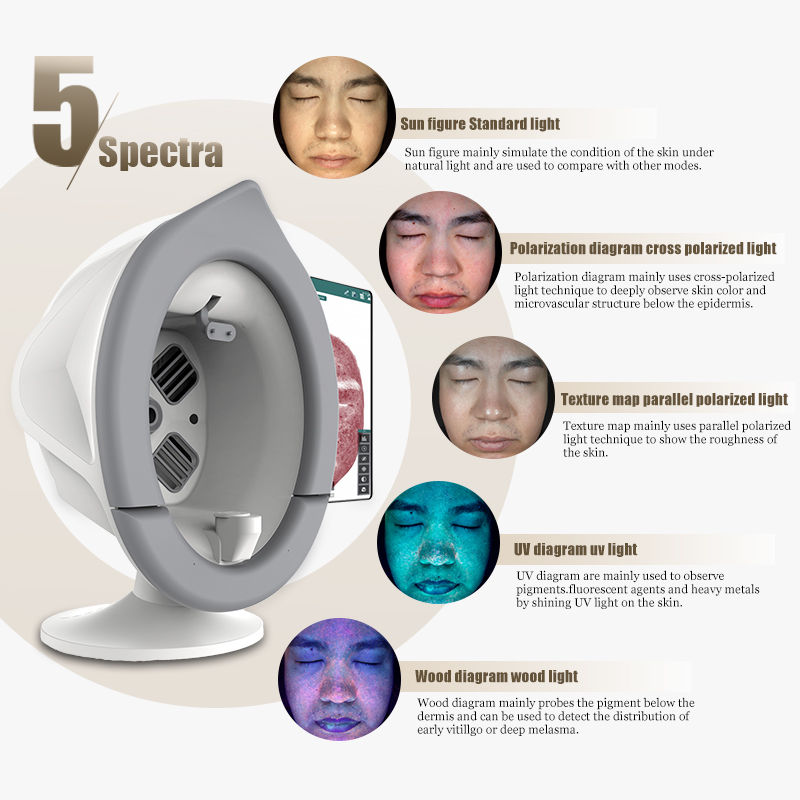
Once you justify the investment, you must define the exact project scope. The modifications generally fall into two distinct categories. You can alter the software layer or re-engineer the physical hardware. Each path carries different timelines, costs, and risks. Carefully adjusting smart skin analysis machine specifications ensures the final product aligns perfectly with your strategic business goals.
Software modifications present the lowest barrier to entry. They demand less capital and deploy rapidly. A complete UI/UX overhaul involves custom branding and tailored report generation. It also allows extensive localized language support. You integrate your visual identity deeply into the patient experience.
API and SDK access represent the next crucial software layer. You build direct digital bridges. These connect the analyzer’s output with your existing clinic management systems. Algorithm tweaking allows you to adjust AI severity thresholds. You align the diagnostic sensitivity with the specific demographic data of your target market. This prevents the system from overly penalizing natural skin variations within specific ethnic groups.
Modifying physical hardware creates a defensible strategic moat. It requires higher investment and significantly longer lead times. You might upgrade optics and sensors. This involves adding higher resolution cameras or integrating specialized lighting modules. You modify the form factor to suit your physical environment. You might transition from a tabletop unit to a handheld device or a standalone retail kiosk.
The implementation reality dictates caution here. Hardware changes drastically impact diagnostic accuracy. Replacing a lens requires rigorous machine learning recalibration. You must conduct extensive clinical validation to maintain testing reliability. The AI must learn how to interpret images through the newly installed hardware.
Customization Type | Primary Examples | Average Lead Time | Strategic Benefit |
|---|---|---|---|
Software UI/UX | Branded interface, customized PDF reports, multi-language support. | 4 to 8 Weeks | Immediate brand elevation and improved patient trust. |
API & SDK Integration | EMR routing, inventory software sync, custom CRM bridges. | 8 to 12 Weeks | Seamless data flow, reduced manual entry, HIPAA compliance. |
Algorithm Adjustments | Proprietary product matching, demographic severity tuning. | 10 to 16 Weeks | Highly targeted upselling and demographic-specific accuracy. |
Hardware Redesign | Custom spectral lenses, kiosk chassis, enhanced optical sensors. | 3 to 6 Months | Unique clinical capabilities and unmatched market differentiation. |
The diagnostic process directly influences retail conversion rates. A standard software interface often fails consumers. It relies heavily on technical jargon. It displays overly clinical data graphs. This approach frequently alienates everyday retail buyers. They struggle to translate raw biometric metrics into actionable daily skincare routines. A confused patient rarely commits to a premium treatment plan.
A custom smart skin analysis machine allows visionary businesses to reverse-engineer the entire consultation process. You design the output backward from your desired outcome. You identify the specific treatments you want to sell. You then configure the interface to prominently highlight the exact skin issues those treatments solve. This ensures a seamless narrative flow from problem identification to solution presentation.
This outcome-focused approach transforms the dynamic. You ensure your client consultations smart skin analysis machine workflows lead directly to high-confidence purchasing decisions. The system presents easy-to-understand visual scores. It directly links a low hydration score to a specific service you provide. This significantly improves your overall consultation-to-treatment conversion rates.
Translate clinical terminology into consumer-friendly language.
Use visual progress sliders instead of complex scatter plots.
Directly link every identified flaw to one specific product.
Enable instant email delivery of the personalized treatment plan.
Include before-and-after simulation modules to build visual proof.
Selecting the right manufacturing partner dictates your project's success. Technical due diligence prevents costly missteps. Never accept initial marketing claims at face value. You must request extensive documentation detailing their AI training datasets. Investigate the dataset size and geographical diversity. Ask specific questions about their internal bias mitigation protocols. A poorly trained AI will generate inaccurate recommendations for diverse patient populations.
You must clearly differentiate between true R&D manufacturers and simple hardware assemblers. Many companies merely assemble off-the-shelf parts. They completely outsource the critical software layer. A reliable smart skin analysis machine supplier employs robust in-house engineering teams. They manage both hardware fabrication and machine learning development under one roof. This guarantees tight integration and faster troubleshooting.
Address commercial realities early in the negotiation process. Define the minimum order quantity for hardware changes immediately. Establish crystal-clear intellectual property ownership boundaries. You must legally own the customized product-matching algorithms they develop for you. Post-deployment support is equally critical. Ensure the supplier provides a robust service level agreement. This contract must cover ongoing bug fixes, operating system compatibility updates, and continuous algorithm retraining.
Ignoring the supplier's software update frequency history.
Failing to define data ownership in the initial contract.
Assuming hardware changes won't affect existing software accuracy.
Skipping the clinical validation phase after modifying optical sensors.
Acknowledge the Investment: Customizing a skin tester represents a serious infrastructure investment, not a superficial aesthetic upgrade.
Identify Strategic Necessity: If your model relies heavily on closed-loop product sales or strict data control, building a custom unit becomes strategically necessary.
Audit Your Bottlenecks: Begin by thoroughly analyzing your current consultation workflows to identify exact failure points.
Draft a Clear PRD: Create a comprehensive product requirements document separating vital algorithm changes from optional hardware tweaks.
Demand Full Ownership: Ensure your final supplier contract explicitly grants you ownership over patient data and customized UI assets.
A: Software UI tweaks generally take 4-8 weeks. Full hardware redesigns, custom optics, and API/algorithm customization can take 3-6 months. This timeline heavily depends on the rigorous clinical testing requirements needed to validate the new sensors.
A: Yes. Changing lenses or modifying the multi-spectral lighting requires the underlying AI model to be retrained. It must be carefully recalibrated to the new image baselines to prevent inaccurate readings and false positives.
A: This must be explicitly defined in your supplier contract. Ideally, enterprise buyers should mandate direct data routing to their own servers via an SDK/API. This ensures 100% data ownership, privacy control, and regulatory compliance.


