
peter @aimyskin.com
+86-18031361872
- All
- Product Name
- Product Keyword
- Product Model
- Product Summary
- Product Description
- Multi Field Search
Views: 126 Author: Site Editor Publish Time: 2026-09-22 Origin: Site


Procuring diagnostic hardware represents a major milestone for growing aesthetic practices. However, purchasing unverified equipment in bulk exposes clinics, spa networks, and distributors to severe financial and reputational risks. Inaccurate imaging easily leads to poor treatment recommendations. This frustrates clients, hurts clinic conversions, and damages your brand authority over time.
A successful procurement process requires a delicate balance. You must weigh clinical-grade accuracy against reliable software stability, strict data compliance, and verifiable supplier accountability. Navigating the crowded marketplace requires a structured evaluation method. You need clear metrics to separate premium manufacturers from generic assemblers.
In this guide, we provide a strict, evidence-based evaluation framework. You will learn how to audit technical specifications, review data security standards, and vet manufacturing partners thoroughly. Ultimately, this checklist will help you shortlist and secure high-ROI diagnostic hardware for your network.
Diagnostic accuracy relies on multispectral imaging capabilities, not just megapixel counts.
Software licensing fees and CRM integration capabilities often define the True Cost of Ownership (TCO).
Validating a supplier requires verifying ISO/CE/FDA certifications and assessing post-sale technical support infrastructure.
Customization options range from basic UI white-labeling to bespoke hardware molds for brand alignment.
Hardware capability defines the ceiling of your diagnostic accuracy. When evaluating professional skin analyzer specifications, you must look beyond basic marketing claims. True clinical efficacy demands sophisticated optical engineering and robust baseline algorithms.
Top-tier diagnostic machines rely on multispectral imaging to reveal subdermal conditions. Standard RGB lighting captures surface-level texture, wrinkles, and visible pores. However, you need deeper penetration for comprehensive analysis. UV (Ultraviolet) lighting exposes sun damage, hidden pigmentation, and porphyrin buildup related to acne. PL (Cross-polarized) lighting eliminates surface glare. It effectively highlights vascular conditions and deeper dermal pigmentation.
Beware of a common industry shortcut. Many generic manufacturers use basic white lighting and apply software filters to simulate UV or PL images. This practice yields wildly inaccurate results. Always demand physical multi-spectrum lenses and verifiable dual-polarization hardware during your evaluation.
Vendors frequently inflate megapixel counts to attract buyers. Yet, a massive megapixel count means nothing if the sensor cannot capture adequate light. Sensor size dictates image clarity far more than pixel density. A larger sensor gathers more light, producing crisp, noise-free images even under varied ambient lighting.
Focal consistency remains equally vital. The device must maintain a fixed distance between the lens and the client's face. Without a stable focal length, comparative before-and-after photos become useless. Look for hardware designs incorporating physical chin rests and automated focal adjustments.
Artificial intelligence serves as a powerful assistive evaluation tool. However, it should never replace clinical judgment. The true value of any AI system depends entirely on its training data. If developers train an algorithm exclusively on a narrow demographic, it will fail in a diverse clinic.
You must question the baseline database training the analyzer’s AI. Does it encompass a wide spectrum of Fitzpatrick skin types? Does it account for diverse age groups and regional skin characteristics? Broad baseline data ensures the AI delivers fair, accurate assessments across your entire patient demographic.
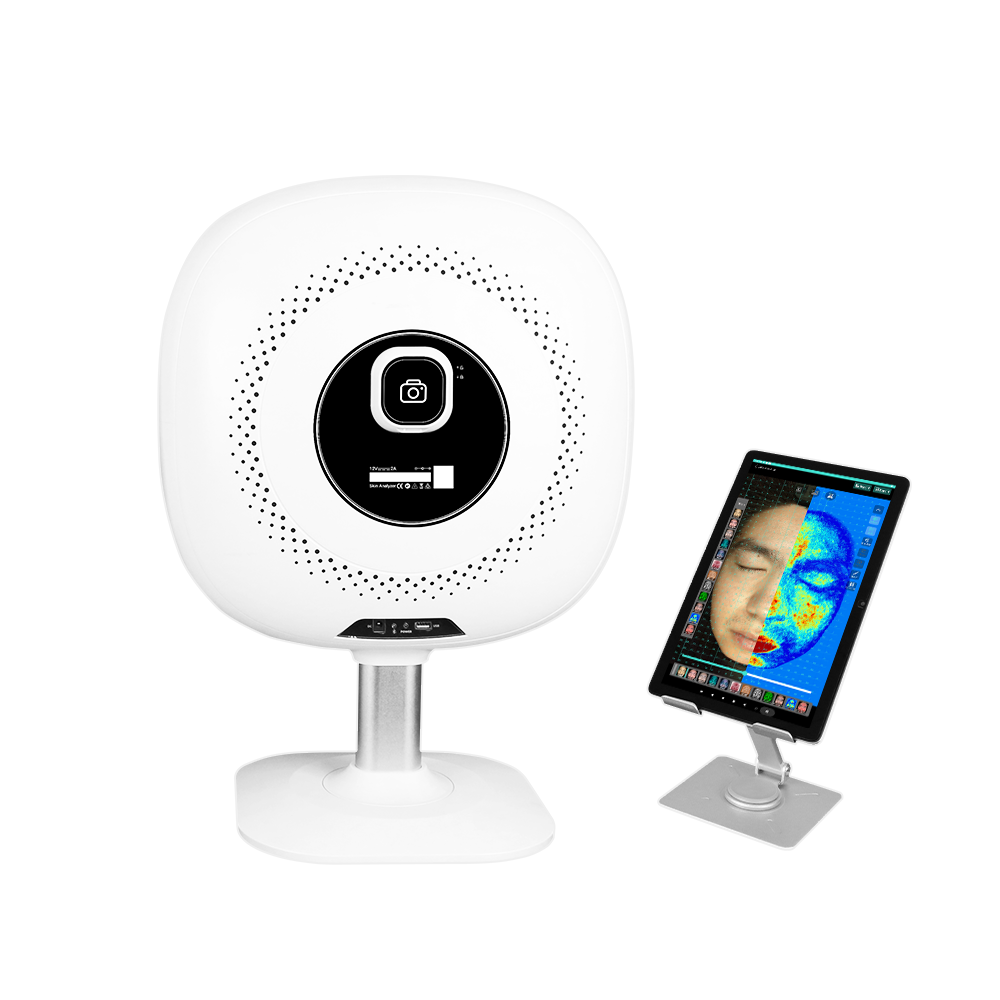
Hardware captures the data, but the software ecosystem dictates how you use it. A high-quality professional skin analyzer must integrate seamlessly into your daily clinic operations.
Isolated diagnostic devices create massive workflow bottlenecks. Staff members waste hours manually entering patient data across multiple platforms. To scale your operations, you need devices offering open APIs or native integrations. These connections push client reports directly to patient files in your existing CRM. Streamlined data flow empowers practitioners to track historical progress effortlessly.
Capturing facial images and medical histories triggers strict regulatory oversight. Data privacy is not optional. You must address GDPR compliance in Europe and HIPAA compliance in the United States. Mishandling patient images invites severe legal penalties.
Buyers must choose between cloud-dependent analyzers and local storage configurations. Both carry unique risks and benefits.
Storage Type | Primary Advantages | Compliance Risks & Challenges |
|---|---|---|
Cloud Storage | Remote access across multiple clinic locations. Automated backups. | Requires robust end-to-end encryption. Higher vulnerability to data breaches. |
Local Storage | Total control over physical data. No recurring cloud hosting fees. | Vulnerable to hardware failure. Requires manual backup protocols. |
Complex spectral data holds little value if clients cannot understand it. The software must translate dense clinical metrics into actionable, consumer-friendly insights. High-converting clinics rely on visual scorecards and automated product recommendations. When the software visually links a specific skin issue to a customized treatment plan, clinic conversion rates rise significantly.
Scaling a business requires strategic procurement. Securing a wholesale equipment professional skin analyzer contract demands careful financial planning and negotiation.
Factory-direct purchases typically involve standard Minimum Order Quantities (MOQs). For baseline models, MOQs might start at 10 to 50 units. Distributors should negotiate tiered pricing structures early in the discussion. Establishing clear price breaks at 100, 250, and 500 units provides a predictable roadmap for your profit margins as you scale.
The initial hardware invoice rarely represents your final expenditure. Smart buyers thoroughly audit all recurring operational costs. Manufacturers often lock features behind paywalls. You must ask about annual software licensing fees. Furthermore, clarify whether cloud storage requires a monthly subscription. Finally, confirm if the manufacturer charges for routine AI algorithm updates. Factor these ongoing expenses into your annual budget.
Equipment downtime directly impacts clinic revenue. You must define acceptable baseline warranties before signing a contract. Industry standards typically offer 1 to 2 years of comprehensive coverage. More importantly, you must understand the logistics of servicing defective units at scale.
Evaluate the Return Merchandise Authorization (RMA) process carefully:
Does the manufacturer require you to ship the entire unit overseas for a simple repair?
Do they provide modular replacement parts (like swapping a broken camera module locally)?
Will they supply a temporary loaner machine to prevent clinic disruptions?
Distributors and franchise networks often want proprietary equipment. Building a custom professional skin analyzer strengthens brand equity and prevents clients from price-shopping identical hardware online.
Software white-labeling presents the fastest path to brand alignment. This approach generally requires a low MOQ. Factories can embed your brand logos directly into the startup sequence. They can alter custom color schemes to match your clinic’s aesthetic. Most importantly, you can hardcode proprietary skincare product recommendations into the final analytical reports. This creates a closed-loop sales ecosystem for your house-brand cosmetics.
Deep hardware customization demands significantly higher capital and volume. If you want a bespoke outer casing, the factory must cast new injection molds. You can request custom lighting configurations or specific screen dimensions. While these modifications create a truly unique product, they require MOQs often exceeding 500 units to justify the tooling costs.
Aggressive hardware modifications introduce substantial implementation risks. Custom molds increase production lead times by several months. Furthermore, altering the physical chassis can unexpectedly affect internal heat dissipation or camera focal lengths. You must mandate rigorous secondary QA testing on prototype units before approving a mass rollout.
Your hardware is only as reliable as the factory producing it. Partnering with a reputable professional skin analyzer supplier protects your long-term investment.
Medical and aesthetic hardware faces strict global regulations. You need a non-negotiable checklist of compliance documents. Request CE marks for Europe, FCC clearance for North America, and RoHS compliance for electronic safety. Ensure the factory holds ISO 13485 certification, which governs medical device quality management. If you operate in a heavily regulated market, check for active FDA registration.
Always verify certificate numbers directly with the issuing bodies. Counterfeit compliance documents plague the overseas manufacturing sector.
Never rely solely on polished trade show brochures. You must assess the factory's actual production capacity. Request a live video tour of the assembly line and testing facilities. If you plan a massive bulk order, hire a third-party auditing firm to inspect the premises physically. Demand supply chain transparency regarding where they source their camera sensors and internal processors.
Even the best hardware experiences occasional software glitches. Evaluate the supplier’s technical support infrastructure rigorously.
Can they deliver timely software patches to fix emerging bugs?
Do they provide comprehensive, English-speaking technical documentation?
Is their engineering team available for remote troubleshooting during your operating hours?
A supplier lacking a responsive support team will leave your clinics stranded during critical failures.
A structured evaluation funnel guarantees a secure procurement process. You must always start by vetting clinical specifications to ensure diagnostic accuracy. Next, filter your options based on software compliance, CRM integration, and data security standards. Finally, secure your investment through strict supplier vetting and compliance verification.
We highly recommend taking a measured approach before committing to a massive bulk contract. Request a sample hardware unit to test the physical build quality. Simultaneously, ask the supplier for a software demo sandbox. Allowing your clinical staff to test the user interface ensures the system will actually streamline your daily operations.
A: For standard off-the-shelf models, factories typically require 15 to 30 days to process and ship a bulk order. However, if you request deep OEM hardware modifications or custom casing molds, lead times easily extend to 60 or 90 days. Always factor shipping times into your deployment schedule.
A: Yes, premium manufacturers offer open APIs and SDKs specifically for this purpose. This allows your developers to push diagnostic reports directly to your custom clinic app. However, you must confirm developer support availability and integration costs with the supplier beforehand.
A: High-end models maintain stable internal environments and rarely need manual calibration. However, ambient lighting in your clinic can affect standard RGB imaging. We recommend installing the device in a room with controlled, consistent lighting and keeping the physical lenses free of dust and smudges.
A: Modern analyzers generally utilize Over-The-Air (OTA) updates via Wi-Fi. This allows you to push patches to your entire network simultaneously. Conversely, cheaper models might require manual updates using a USB drive, which becomes a logistical nightmare when managing dozens of clinic locations.


