
peter @aimyskin.com
+86-18031361872
- All
- Product Name
- Product Keyword
- Product Model
- Product Summary
- Product Description
- Multi Field Search
Views: 157 Author: Site Editor Publish Time: 2026-08-10 Origin: Site


Aesthetic and dermatological clinics are currently undergoing a massive operational shift. They are rapidly transitioning from subjective 2D photography to highly objective 3D facial analysis. A clinical-grade 3D face skin scanner represents much more than a simple assessment tool. It operates as a critical bottom-of-funnel conversion engine for high-ticket skincare treatments. Standard clinic photos fail to quantify deep dermal conditions accurately. They leave patients guessing about actual treatment efficacy.
This article provides a comprehensive, vendor-neutral, and evidence-based framework. You will learn exactly how to evaluate hardware specifications, software ecosystems, and operational workflows. We will guide you through maximizing clinic adoption and improving patient trust. By matching technical capabilities to your daily workflow, you guarantee clinical success. We focus entirely on tangible metrics, precise optics, and secure data handling.
Aligning scanner form factors (benchtop vs. handheld) with clinic foot traffic and staff technical capabilities is critical to adoption.
Evaluating 3D face skin scanner specifications requires looking beyond megapixel counts to focus on multi-spectral lighting and volumetric accuracy.
Selecting a 3D face skin scanner supplier depends heavily on API accessibility, post-sale calibration support, and data compliance (HIPAA/GDPR).
Real-world ROI relies on mitigating implementation risks like software lock-in and extended consultation times.
Standard photos simply fail to quantify subsurface conditions. They completely miss critical issues like latent UV damage and deep porphyrins. This lack of visibility often leads to patient skepticism during treatment proposals. You cannot easily recommend a deep chemical peel if the patient only sees surface wrinkles. Practitioners need tools to reveal what lies beneath the epidermis accurately.
We define clinical success through specific, trackable operational improvements. You must monitor these key performance indicators closely.
Increase in same-day treatment bookings: An objective scan immediately builds trust. It shifts the conversation from selling to educating, thereby boosting your consultation conversion rate.
Improved patient retention: Volumetric progress tracking provides undeniable "Before & After" proof. Patients stay loyal when they see actual dermal volume changes over several months.
Reduction in consultation time: Automated AI analysis reports should streamline your daily intake process. Faster intakes allow your staff to see more patients daily.
Practitioners must balance technical data and human empathy carefully. You build trust by using evidence-oriented visualizations rather than exaggerated software predictions. Flashy future predictions often set entirely unrealistic treatment expectations. Patients appreciate grounded honesty. A robust commercial skincare 3D face skin scanner anchors your consultations in undeniable, clinical reality.
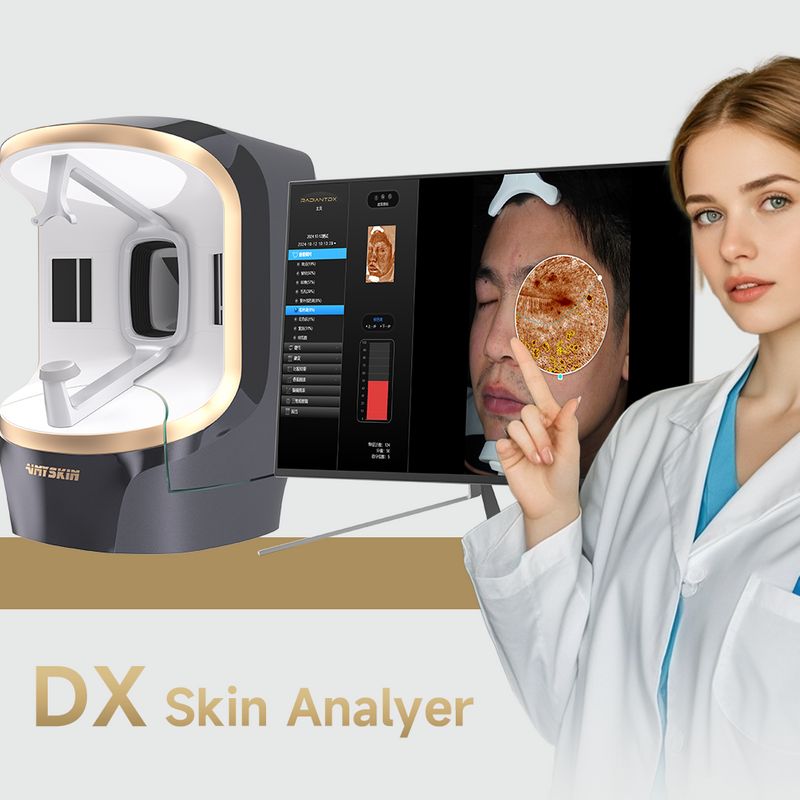
Do not simply look at basic megapixel counts. You must scrutinize the multi-spectral lighting arrays embedded within the hardware. Different light wavelengths reveal completely different biological markers.
RGB (Standard Light): Use this mode for basic surface texture. It accurately maps out superficial wrinkles, fine lines, and visible pores.
Cross-Polarized & Parallel-Polarized Light: These specialized lighting modes eliminate surface glare completely. They look slightly deeper to reveal hidden vascularity and pigmentation irregularities.
UV / Wood's Light: This remains absolutely essential for modern dermatological clinics. It identifies porphyrins, which represent acne-causing bacterial clusters. It also highlights latent sun damage hiding beneath the upper skin layers.
Aesthetic medicine requires immense spatial precision. You must require strict sub-millimeter accuracy from your hardware. Ideally, look for 3D face skin scanner specifications listing 0.1mm to 0.5mm tolerances. This exactness lets you track very subtle changes in dermal volume. For example, it objectively proves dermal filler efficacy or non-surgical skin tightening results over consecutive visits.
Consider how the scanner fits into your broader clinic network. Verify CRM compatibility early in the procurement process. Carefully compare cloud storage versus local storage architectures. Furthermore, demand absolute transparency regarding underlying AI algorithms. Avoid "black box" diagnostic scores. If practitioners cannot confidently explain a score to their patients, they will eventually stop using the feature altogether.
The chart below outlines standard lighting modes and their primary clinical diagnostic targets.
Lighting Mode | Target Wavelength / Type | Primary Clinical Application |
|---|---|---|
RGB Standard Light | White Light Spectrum | Surface wrinkles, visible pores, rough texture |
Cross-Polarized | Filtered White Light | Vascularity, rosacea, deep dermal pigmentation |
Parallel-Polarized | Aligned Filtered Light | Skin surface smoothness, epidermal reflectance |
UV Light | Ultraviolet (approx. 365nm) | Porphyrins (acne bacteria), latent photodamage |
These large, stationary units dominate high-end aesthetic practices. They provide a highly controlled imaging environment.
Pros: These machines offer perfectly controlled lighting environments. They ensure zero operator handshake during capture. This grants you maximum reproducibility for strict baseline comparisons.
Cons: They require a surprisingly large physical footprint. They remain mostly immovable once installed. We strongly recommend them for high-volume medspas dedicating specific rooms to patient onboarding.
These compact devices prioritize mobility. Staff can move them effortlessly between various treatment rooms.
Pros: These devices provide excellent portability. They typically feature a lower initial purchase barrier and remain highly space-efficient for urban clinics.
Cons: They rely heavily on operator physical skill. Staff members must maintain consistent angles and distances manually. Furthermore, ambient room lighting can easily skew the final visual results.
These specialized setups serve entirely different clinical environments. A custom 3D face skin scanner configuration is ideal for bustling retail skincare environments. They excel where self-guided patient onboarding drives daily foot traffic. Kiosks allow patients to initiate their own scans while waiting for a practitioner.
Whenever you introduce new clinical hardware, anticipate a temporary productivity drop. We call this phenomenon the adoption dip. Expect a 2-3 week learning curve across your practice. Consultation times will temporarily increase as staff learn the new software user interface. Do not panic; this represents a normal, unavoidable operational phase. Proper upfront training minimizes this delay.
Hardware inevitably shifts over extended periods of time. Devices require routine recalibration to maintain their analytical credibility. Lenses settle slowly, and sensitive optical sensors accumulate minute dust particles. Without proper calibration, you lose diagnostic accuracy. Factor this recalibration process directly into your standard clinic maintenance schedules.
Detailed facial scans constitute highly sensitive biometric health data. Your decisions between local servers and remote cloud storage carry massive legal weight. These choices must align directly with strict regional privacy regulations. You must rigorously comply with HIPAA, GDPR, or CCPA frameworks. Failure here carries massive financial and legal liabilities for your business.
High-fidelity scans reveal every hidden facial flaw. They can easily trigger severe patient dysmorphia or emotional distress. You must train your clinical staff extensively on empathetic, solution-oriented communication. Teach them to present complex findings gently. Avoid fear-based selling tactics at all costs. The goal remains education, not intimidation.
First, determine your exact business scale and branding requirements. Do you need a white-labeled product tailored for a large regional franchise operation? Or does a standard off-the-shelf model meet your current clinical needs perfectly? White-labeling takes more time but builds stronger brand equity.
Partnering with the right 3D face skin scanner supplier dictates your long-term success. Hardware will occasionally fail. You need a reliable safety net.
Look for very clear Service Level Agreements (SLAs) regarding emergency hardware replacement times.
Demand full financial transparency on software licensing. You need to know if you are paying for a perpetual license or getting locked into SaaS monthly fees.
Check for open API capabilities immediately. You need this if you plan on integrating the device into proprietary clinic management software.
Never commit blindly to a new hardware ecosystem. Require a localized demo period before signing contracts. Test the specific scanner under your clinic's actual ambient lighting conditions. Push it through your own wireless network constraints to verify processing speeds. Real-world testing exposes flaws unseen in marketing brochures.
You must summarize your specific decision matrix carefully. Match underlying hardware specs strictly to your daily clinical needs. Likewise, align the device form factors directly to your clinic workflows and floor plans.
Always prioritize consistent, reproducible imaging data. Seamless software integration holds far more long-term value than flashy but unverifiable AI predictions. Consistency builds deep patient loyalty and trust over years of treatment.
Take action today to modernize your clinic. Download a comprehensive spec-comparison checklist for your procurement team. Alternatively, schedule a thorough consultation with a technical procurement specialist to assess your exact clinical layout.
A: A high-quality scanner typically lasts 3 to 5 years. Its functional lifespan is often limited by software obsolescence rather than complete hardware failure. Regular maintenance and recalibration extend usability significantly.
A: The physical image capture process takes roughly 10 to 20 seconds. Subsequent AI processing and detailed report generation take 1 to 3 minutes. This duration depends entirely on your local internet speed and the desired scan depth.
A: Integration capabilities vary widely by manufacturer. Direct synchronization requires specific open API access. You must verify these software bridges during the initial procurement stage before finalizing any long-term contracts.
A: No. These sophisticated devices function strictly as visual evaluation and patient communication tools. They are designed to support professional clinical judgment, not replace it entirely. They lack the nuanced diagnostic capability of human practitioners.


