
Views: 126 Author: Site Editor Publish Time: 2026-07-15 Origin: Site


Aesthetic medicine rapidly shifts from subjective consultations toward data-driven patient assessments. A robust commercial skin analyzer serves as more than a simple diagnostic tool. It acts as a primary driver for treatment conversions. You can utilize it to boost patient retention significantly. Many skeptical clinic owners struggle when evaluating these modern machines. You must separate clinical-grade imaging from low-end, gimmick-heavy devices. We recommend focusing firmly on verifiable optical technologies. Secure software ecosystems also matter immensely. We designed this guide to provide a realistic evaluation framework. You will learn to shortlist a device based on true clinical utility. A precise machine delivers exceptional operational advantages. You can easily transform invisible skin damage into actionable treatment plans. Read on to discover the ideal imaging solution for your aesthetic practice.
Hardware dictates baseline accuracy: Reliable analysis requires multi-spectral imaging (RGB, UV, PL) and high-resolution optics, not just standard photography.
Software drives the conversion: An effective AI skin analyzer must translate complex dermatological data into a visual "Wow moment" that patients easily understand.
Integration over isolation: Prioritize devices that seamlessly export reports to existing clinical CRMs and track longitudinal patient progress.
Subjective visual inspections often fall short during modern aesthetic consultations. Patients increasingly demand empirical evidence before committing to invasive procedures. Visual data effectively replaces verbal persuasion. It transforms casual inquiries into booked appointments.
Visual evidence instantly overcomes deep-seated patient skepticism. A handheld mirror cannot show underlying photodamage. Modern imaging reveals invisible UV damage clearly. It exposes deep dermal pigmentation before it surfaces. Patients trust objective data displayed on a high-definition screen. They immediately grasp the severity of their specific condition. This visual realization bridges the crucial trust gap.
Data directly accelerates your clinical treatment uptake. You can link objective metrics to high-margin treatment plans. A reliable skin diagnosis device highlights specific textural flaws. You can then confidently recommend laser resurfacing. It accurately detects hidden vascular issues. You can promptly suggest targeted chemical peels. The machine visually validates medical-grade skincare recommendations. Patients accept comprehensive packages when they see undeniable proof.
Practitioner variability creates inconsistent clinic experiences. Standardizing consultations removes this risky inconsistency. Establish a repeatable workflow for every new patient. Every staff member follows the exact same baseline protocol. This guarantees uniform service quality across your entire practice.
Best Practice: Mandate a full facial scan before every initial consultation. Make it a non-negotiable step in your patient intake process.
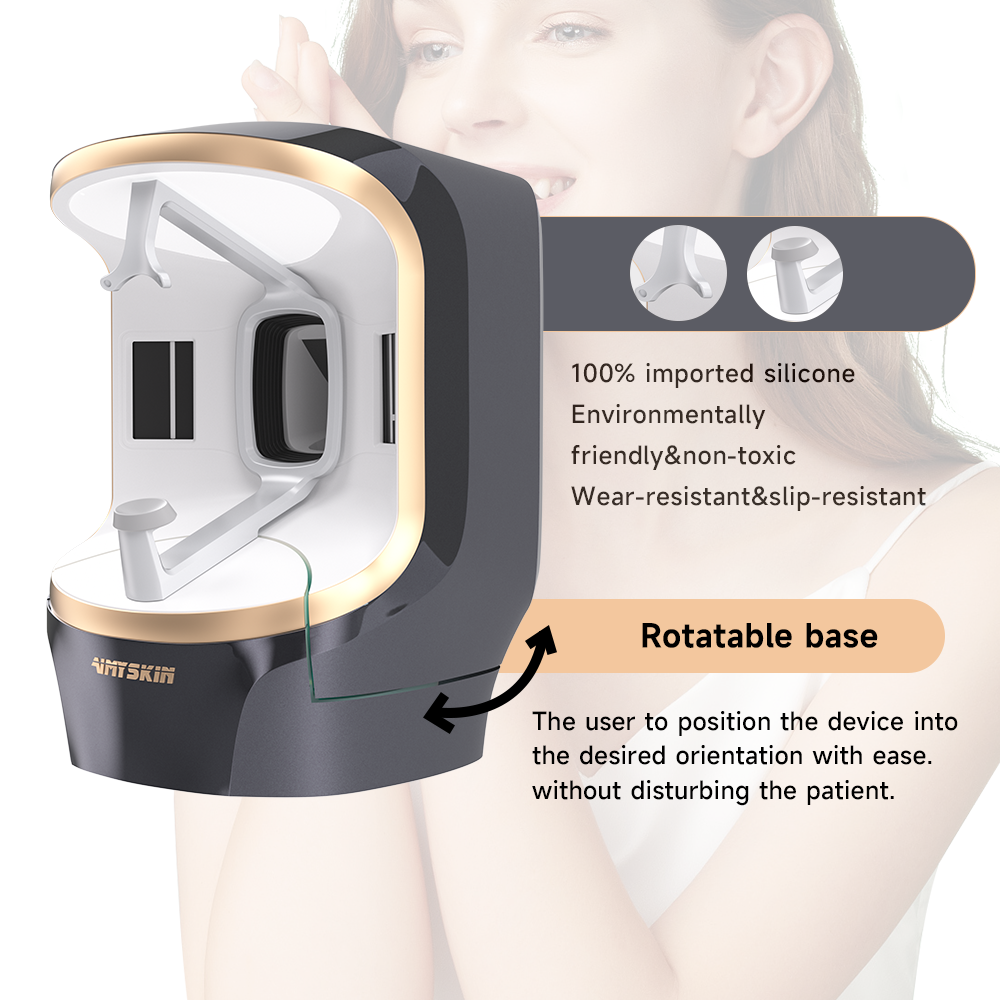
You must evaluate both physical optics and algorithmic power carefully. Outstanding hardware captures flawless raw data. Intelligent software translates that data into understandable metrics. Both elements dictate the success of a facial skin analysis machine.
Standard RGB photography fails to capture deep dermal issues. True clinical imaging requires advanced multi-spectral illumination.
Multi-Spectral Imaging: Seek true UV lighting capabilities. UV exposes dangerous porphyrins and hidden sun damage. Cross-polarized (PL) lighting eliminates surface glare entirely. It highlights underlying vascular conditions vividly. Subdermal pigmentation becomes glaringly obvious.
Camera Resolution: Assess the raw megapixel count closely. Blurry images ruin diagnostic credibility.
Consistency and Hood Design: Evaluate the physical hood design. A deep hood blocks ambient room light entirely. Changing room lights will ruin comparative baseline photos. A proper hood ensures repeatable lighting over months or years.
Hardware captures the image accurately. Software must analyze it without distortion.
Visual clarity matters far more than flashy gimmickry. Software must clearly delineate real skin metrics. It should precisely measure moisture, sebum, pores, and wrinkles. Avoid systems utilizing exaggerated, cartoonish filtering. These filters break patient trust immediately.
Longitudinal tracking represents a critical software feature. You need the ability to overlay "Before and After" scans precisely. The machine must align facial markers automatically. This proves treatment efficacy to the skeptical patient visually.
Common Mistake: Relying on standard tablets without a controlled lighting hood. Ambient shadows will alter the software's severity scoring drastically.
Artificial intelligence transforms raw pixels into clinical insights. However, not all algorithms provide equal accuracy. You must scrutinize the underlying data ecosystem.
Question the vendor regarding their AI training dataset. Algorithms must account for diverse Fitzpatrick skin types. They must recognize distinct ethnic variations. A system trained only on Type II skin fails Type VI skin. It misdiagnoses melanin levels and creates skewed scoring. A dependable 3D skin analyzer adapts scoring baselines across diverse demographics.
Data holds no value unless patients understand it. The system should automate patient-friendly PDF reports. These reports must highlight the top three clinical concerns clearly. They should recommend specific clinic treatments automatically. This automation saves your staff valuable consultation time.
Facial scans qualify as sensitive biometric data. You must assess local storage versus cloud storage protocols. Local storage keeps data offline and generally secure. Cloud storage permits convenient multi-room access. Ensure the device complies with regional patient privacy regulations strictly. HIPAA and GDPR compliance remain non-negotiable requirements.
Purchasing the device represents only the first step. Daily operational implementation determines its true value. Evaluate the practical realities before finalizing your decision.
Consultations should never suffer delays from slow processing. Evaluate the time it takes to boot the system fully. A sluggish spa skin scanner annoys both patients and staff. Image capture must happen within seconds. Report generation should occur almost instantaneously. Frictionless workflows keep busy clinic schedules running on time.
Identify the learning curve for your estheticians. Complex interfaces lead directly to staff abandonment. They will revert to basic handheld mirrors. Look for vendors offering comprehensive onboarding programs. Ongoing video tutorials ensure new hires learn the system quickly. Simple touch-screen navigation drastically improves daily staff adoption.
Physical maintenance heavily impacts device uptime. Detail the specific tablet or iPad operating requirements. Understand the reality of hardware warranties carefully. Determine the protocol for shipping heavy devices for repairs. Lengthy repair times disrupt clinic operations severely. Clarify if the machine requires proprietary consumable components.
Different clinics require different operational features. Match the machine's capabilities to your specific daily volume.
High-volume clinics process dozens of patients daily. They must prioritize exceptionally fast processing speeds. Robust CRM API integrations remain vital for large teams. Multi-room network access allows doctors to view reports remotely. They can consult on separate tablets while the machine scans others.
Solo practitioners operate with different daily constraints. They should focus on device portability. Integrated local storage removes the need for complex network setups. Smaller footprints fit easily into cozy treatment rooms.
Clinic Volume Feature Comparison Chart
Clinic Type |
Primary Requirement |
Ideal Storage Protocol |
Networking Needs |
|---|---|---|---|
High-Volume MedSpa |
Rapid Processing & APIs |
Secure Cloud Storage |
Multi-Room Wi-Fi Access |
Boutique Clinic |
Compact Footprint |
Integrated Local Storage |
Standalone Operation |
Solo Esthetician |
Portability & Ease of Use |
Integrated Local Storage |
Standalone Operation |
Never rely solely on pre-loaded vendor demonstration profiles. These profiles always show perfect, seamless results. Request live demonstrations using your own staff members. Select a staff member possessing known skin concerns. Verify if the machine detects these issues accurately. This real-world test proves the algorithm's actual clinical validity.
You must adopt a strategic procurement mindset. Buy these devices for strict optical consistency. Procure them to enhance daily patient communication. Do not purchase them merely for a futuristic plastic shell. The right machine elevates your entire clinical workflow seamlessly. It transforms skeptical prospects into loyal, long-term patients.
We recommend taking an immediate next step today. Audit your current consultation conversion rates closely. Define your required return on investment clearly. Understand your specific workflow bottlenecks before requesting vendor demonstrations. Careful preparation ensures you select the perfect imaging device for your growing practice.
A: Standard 2D cameras only capture surface-level visuals using basic visible light. A true multi-spectral analyzer utilizes specific UV and cross-polarized lighting. It penetrates the epidermis to reveal hidden vascular damage, deep pigmentation, and bacterial porphyrins. Advanced depth-mapping algorithms then construct a topographical 3D model of facial contours.
A: Clinics frequently observe a rapid return on investment within three to six months. The machine immediately visualizes hidden damage. This visual proof drastically increases high-margin treatment acceptance rates. It also boosts daily medical-grade skincare product sales significantly by providing undeniable evidence of the patient's specific needs.
A: No. These machines function strictly as aesthetic evaluation tools. They highlight textural anomalies, hydration levels, and photodamage. They are not FDA-cleared diagnostic devices. Practitioners must never use them to formally diagnose skin cancer, melanomas, or severe medical pathologies. They serve only to guide aesthetic enhancement plans.
A: Integration depends heavily on the specific vendor's API availability. Some premium devices push data seamlessly into popular clinical CRMs. However, many standard closed-loop systems do not offer direct software integration. They require staff to manually export PDF reports and attach them to the patient's digital file.


