
peter @aimyskin.com
+86-18031361872
- All
- Product Name
- Product Keyword
- Product Model
- Product Summary
- Product Description
- Multi Field Search
Views: 132 Author: Site Editor Publish Time: 2026-08-18 Origin: Site


Aesthetic clinics face a persistent business challenge. Clients often drop out between the initial consultation and the actual treatment booking. This happens because subjective visual skin assessments leave patients unconvinced. They hear your recommendations but fail to see the underlying necessity. Now, a massive technology shift is replacing guesswork entirely. Clinics are moving rapidly from basic magnifying lamps to data-driven diagnostics. We see this shift fundamentally changing how practitioners and patients communicate.
This guide provides clinic owners and clinical directors a complete framework. You will learn how to evaluate the ROI, operational impact, and technical criteria of integrating an aesthetic centers facial skin scanner machine into your practice. We will explore everything from essential imaging modes to software validation. By standardizing your consultation process, you can bridge the gap between initial client interest and long-term treatment commitment.
Conversion Driver: High-resolution skin scanners shift the consultation dynamic from "selling" to "educating," verifiably increasing treatment acceptance rates.
Objective Baselines: Multi-spectral imaging establishes measurable starting points, protecting clinics from disputes over treatment efficacy.
Critical Specs: Purchasing decisions must prioritize specific camera resolutions, lighting modes (RGB, UV, PL), and software accuracy over superficial design.
Sourcing Strategy: Partnering with a reliable facial skin scanner machine supplier ensures proper staff training, software integration, and localized warranty support.
Showing visual evidence accelerates client decisions. Patients routinely push back on premium treatment plans. They simply cannot see the microscopic damage underneath their skin. A high-quality facial skin scanner machine changes this dynamic entirely. Practitioners use it to reveal hidden UV damage, active porphyrins, and vascular conditions. This shifts the conversation immediately. You no longer have to sell a service. You simply educate the client using their own data. They quickly grasp why they need clinical intervention. When patients view their own sunspots illuminated on a high-definition screen, skepticism vanishes. They book corrective laser packages much faster.
Standardized baseline data is non-negotiable today. You must objectively prove the efficacy of long-term treatments. Chemical peels and laser series take months to show surface-level results. Clients often forget their starting point. They might complain after three sessions, claiming nothing has changed. Multi-spectral imaging creates a highly accurate baseline. You can pull up the initial scan and compare it directly to current progress. This visual proof secures long-term client retention. It also protects your clinic from unfair disputes regarding treatment outcomes. Objective metrics eliminate emotional client dissatisfaction.
Connecting scanner findings to product sales forms a highly effective workflow. Advanced software analyzes specific skin metrics systematically. Your staff can seamlessly integrate these findings into daily operations.
The device scans for lipid layer disruption or profound dehydration.
The software generates an algorithmic score for these exact parameters.
Practitioners link these specific findings directly to in-house retail recommendations.
The client receives a printed report detailing both the problem and the matched product.
This operational workflow removes pushy sales tactics. Patients buy medical-grade skincare because they clearly see their barrier is compromised. Retail attach rates soar when clients recognize a targeted solution for a documented problem.
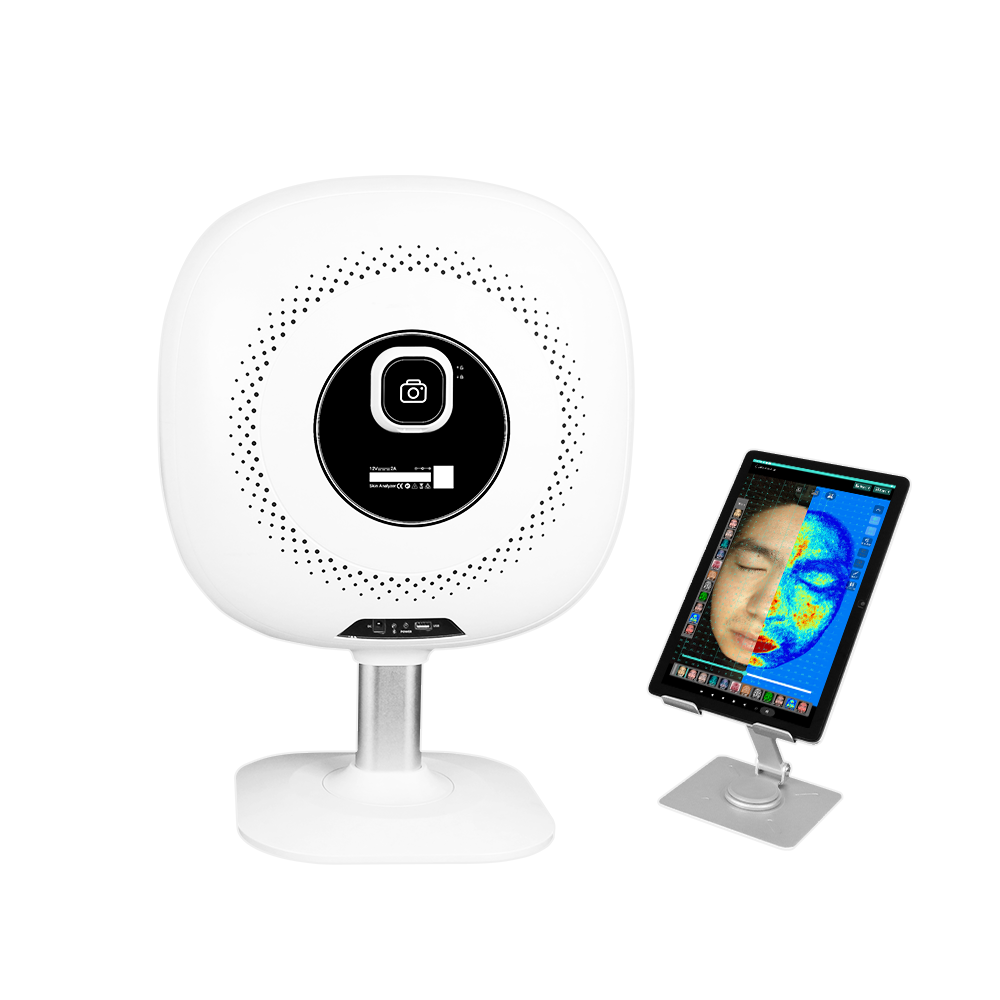
Proper subsurface diagnostics require specific lighting environments. Standard RGB light captures surface textures, wrinkles, and visible pores. Cross-polarized (PL) lighting eliminates surface glare completely. This allows practitioners to view vascular conditions and hidden pigmentation. Ultraviolet (UV) lighting reveals deeper porphyrins, sebum distribution, and severe photo-damage. You cannot compromise on these three modes. They form the foundation of clinical accuracy.
We must also evaluate 2D multispectral imaging versus advanced 3D contour mapping. A 2D system works well for basic color variation and surface metrics. However, assessing volume loss requires accurate depth perception. A 3D scanner maps facial contours precisely. It reveals subtle sagging, jowl formation, and structural asymmetry. 3D mapping provides indispensable data for injectable treatments.
Imaging Mode | Target Analysis | Clinical Benefit |
|---|---|---|
RGB Light | Fine lines, visible pores, rough texture | Establishes a baseline for surface-level resurfacing treatments. |
Cross-Polarized (PL) | Vascularity, deep pigmentation, redness | Guides IPL and targeted laser therapy plans. |
Ultraviolet (UV) | Porphyrins, UV damage, excessive sebum | Directs acne management and medical-grade sunscreen recommendations. |
3D Contour Mapping | Volume loss, jowling, facial asymmetry | Validates dermal filler and structural lifting procedures. |
Many buyers focus entirely on the camera resolution. They assume higher megapixels guarantee better diagnostics. This is a common mistake. Hardware is largely irrelevant without robust AI diagnostic algorithms. You must prioritize clinically validated software. The algorithm determines the accuracy of the skin age calculation. It identifies specific lesion types and generates actionable reports. When you review facial skin scanner machine specifications, prioritize software validation and algorithm processing speed. Algorithms trained on diverse, multi-ethnic datasets prevent diagnostic bias and ensure reliable results across your entire patient demographic.
Patient privacy remains a strict regulatory requirement. Devices capture highly identifiable facial images. This triggers HIPAA or GDPR compliance risks depending on your region. You must understand where the machine stores patient data. Local servers keep data entirely inside your physical clinic. This reduces remote breach risks but requires diligent manual backups. Cloud-based software offers seamless multi-room access and automatic syncing. However, you must verify the cloud provider uses end-to-end encryption. Always ask vendors to clarify their data compliance frameworks during your initial evaluation.
A cohesive clinic environment builds immense trust. When clients see a generic, unbranded machine, they might search the internet to price-shop the equipment. This cheapens the clinical experience. Investing in a custom facial skin scanner machine prevents this issue entirely. White-labeling the exterior hardware aligns it with your clinic's specific aesthetic. Customizing the software user interface further elevates your clinical authority. Clients perceive the diagnostic process as a proprietary, premium service exclusive to your practice. They recognize your clinic as a specialized authority.
Custom systems offer deep technical capabilities. Standard machines generate generic skincare advice. A customized system maps the algorithmic recommendations directly to your specific inventory.
You can upload your exact skincare brand partnerships into the software backend.
You can link specific diagnostic triggers to your signature treatment protocols.
The final patient report prints with your logo and your precise product names.
This tailored integration removes friction from the checkout process. The client leaves the consultation room with a highly specific, immediately actionable prescription. They know exactly which serum to purchase at your front desk.
Adopting new technology always introduces temporary friction. Diagnostic scans require an additional five to ten minutes per initial consultation. This impacts daily scheduling. You must reorganize your front-of-house workflows effectively. Have dedicated intake staff perform the scan before the patient sees the lead practitioner. This keeps the provider focused entirely on interpreting the data and closing the treatment plan. Proper scheduling adjustments prevent lobby bottlenecks. A well-designed workflow ensures the scanning process feels like a luxury add-on rather than an administrative delay.
A sophisticated machine is only as effective as the practitioner using it. Poorly trained staff will capture inconsistent images. They might fail to clean the lens or position the client's chin incorrectly. This corrupts the comparative data. You must emphasize comprehensive vendor training programs.
Require hands-on practice for all front-desk and clinical staff.
Establish standard operating procedures for ambient lighting control in the consultation room.
Test staff on their ability to explain primary data points confidently to patients.
Watch out for software that over-promises AI capabilities. Some systems feature dramatic tools claiming to predict a patient's aging process ten years into the future. These vanity metrics often lack peer-reviewed dermatological backing. They can scare clients rather than educate them responsibly. Stick to concrete, current-state metrics. Focus on measurable hydration levels, visible UV damage, and pore congestion. Accurate, present-day data drives ethical and highly effective treatment planning. Trust builds when you present verifiable facts.
Your diagnostic device serves as a core revenue driver. If the machine goes down, your consultation conversion rates drop immediately. Assess the vendor's Service Level Agreement (SLA) before purchasing. You need guaranteed response times for hardware troubleshooting. You also need a clear roadmap for future software updates. A reliable supplier provides continuous remote diagnostics to fix software glitches instantly. They should offer dedicated support channels tailored to medical professionals.
Modern clinics run on connected digital ecosystems. Your new scanner should not operate in an isolated silo. Evaluate the vendor's software API carefully. It must integrate seamlessly with your existing clinic management software. It should easily push diagnostic reports directly into your Electronic Medical Records (EMR) system. This seamless integration saves staff countless hours of double data entry. It also ensures patient files remain comprehensive and legally sound.
Lenses and internal light bulbs degrade over time naturally. Consistent baseline data requires perfect hardware operation throughout the machine's lifespan. Review the standard expectations for hardware replacement cycles. Ask the supplier about their lens calibration support. A professional vendor will outline exactly how and when to calibrate the machine. They will offer robust warranty coverage. This protects your investment during its critical first few years of clinical use.
A diagnostic scanner functions as much more than a simple clinical tool. It serves as a core revenue-generating asset for any modern aesthetic center. It completely removes subjectivity from patient consultations. Visual evidence transitions your staff from salespeople into trusted educators. This naturally drives higher treatment acceptance rates. It also improves long-term client retention by providing undeniable proof of clinical results.
Decision-makers should immediately audit their current consultation conversion rates. Identify exactly where prospective patients drop out of your sales funnel. Do not rely entirely on promotional brochures from manufacturers. Request standardized, data-backed demonstrations from your shortlisted suppliers. Test the software accuracy using real patients in your clinic. This practical evaluation ensures you select a system that genuinely enhances your operational workflow and clinical outcomes.
A: Most clinics achieve full ROI within three to six months. This timeline depends heavily on increased booking velocity for premium treatment plans. The device also dramatically boosts retail attach rates. When clients clearly see their underlying skin damage, they purchase recommended medical-grade skincare products immediately following the consultation.
A: No, it cannot replace a qualified medical professional. These scanners serve as assistive diagnostic tools designed strictly for aesthetic treatment planning. They analyze surface and subsurface conditions like UV damage and texture. They are not intended for the medical diagnosis of serious pathologies like melanoma or severe skin diseases.
A: The learning curve is remarkably short. Most clinic staff learn to capture consistent baseline images within a single afternoon of training. Interpreting primary data points takes a few days of hands-on practice. Modern systems feature intuitive user interfaces that guide staff step-by-step through the entire scanning and analysis process.
A: Standard maintenance is minimal but crucial. Staff should clean the chin rest and lens daily using approved wipes. The software typically updates automatically via a secure Wi-Fi connection. Manufacturer calibration checks are usually recommended once a year to ensure the lighting and camera sensors maintain perfect diagnostic accuracy.


