
peter @aimyskin.com
+86-18031361872
- All
- Product Name
- Product Keyword
- Product Model
- Product Summary
- Product Description
- Multi Field Search
Views: 0 Author: Site Editor Publish Time: 2026-09-12 Origin: Site


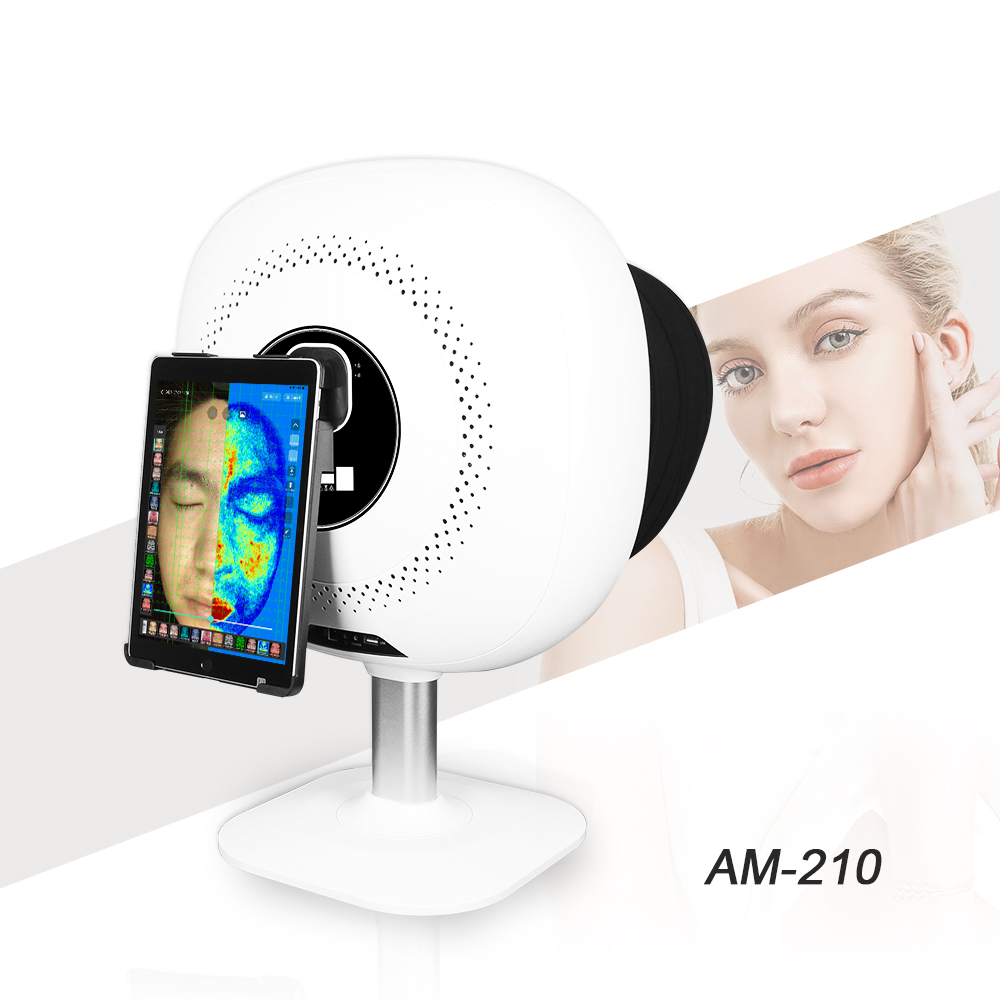
The second capability of AIMYSKIN is turning images into data. Through a million-level skin database, AI large model, RBX analysis, and ROI regional analysis, the system quantifies red zone, brown zone, pores, texture, melanin, and porphyrin indicators.
AIMYSKIN AI skin analyzers analyze five major symptom categories and more than 30 detection dimensions, and predict trends in spots, wrinkles, and aging over the next five to ten years.
Detection is completed in eight seconds, with one-click reports exportable via QR code or email.
This means that AI skin analyzers do more than capture facial images. They transform visual skin information into measurable data, scores, maps, comparisons, and trend information that professionals can use during skin consultations.
The basic technical process can be summarized as:
Skin Images → AI Recognition → Quantitative Analysis → Scores & Skin Age → Trend Prediction → Intelligent Report → Professional Consultation
The value of AI skin analysis therefore lies in connecting imaging technology with quantitative data and making skin information easier to understand, compare, and communicate.
Traditional visual consultation often depends heavily on observation and verbal descriptions.
Statements such as “your pores look enlarged,” “your pigmentation appears more visible,” or “your skin seems sensitive” can be difficult for customers to understand objectively.
AI skin analyzers provide another layer of information by transforming selected visual characteristics into values, scores, maps, and structured analysis results.
AIMYSKIN combines several technologies in this process:
Million-Level Skin Database
AI Large Model
RBX Analysis
ROI Regional Analysis
Multi-Dimensional Skin Quantification
AI Trend Prediction
Intelligent Report Generation
Together, these technologies help transform skin images into information that can be used more systematically during professional consultations.
Stage | Technology / Process | Output |
|---|---|---|
1. Image Acquisition | Multi-dimensional skin imaging | Facial skin images |
2. AI Processing | AI large model + million-level database | Recognition of skin characteristics |
3. Regional Analysis | RBX analysis + ROI regional analysis | Targeted skin-area information |
4. Quantification | AI quantitative algorithms | Values, scores and maps |
5. Comprehensive Evaluation | Multi-dimensional data integration | Comprehensive score and skin age |
6. Trend Prediction | AI algorithms + database comparison | 5–10 year trends |
7. Report Generation | Intelligent reporting | QR code / email report |
This workflow allows professional AI skin analyzers to connect image acquisition, quantitative analysis, visualization, and customer communication within one process.
The quantitative analysis performed by AIMYSKIN AI skin analyzers can be understood in three layers.
Red zone area, brown zone area, pore count, texture roughness, melanin distribution, and porphyrin fluorescence intensity can all be quantified into values or scores.
Numbers shift consultation from “I think” to “data shows.”
This is the first step toward objective communication.
Instead of only showing a customer a facial photograph, AI skin analyzers can provide measurable or visualized information for individual skin characteristics.
Typical quantitative indicators include:
Red Zone Area
Brown Zone Area
Pore Count
Texture Roughness
Melanin Distribution
Porphyrin Fluorescence Intensity
This information can make it easier for professionals to explain why a particular skin concern has been identified and which areas deserve attention.
The system generates a comprehensive skin score and skin age, integrating aging, sensitivity, texture, pigmentation, and pores into comparable indicators.
A customer may be 37 years old but have a skin age of 42.
This contrast is highly impactful because it translates abstract skin condition into a single, understandable number.
For professional users of AI skin analyzers, comprehensive scoring can simplify complex information during a consultation.
Instead of explaining every indicator independently from the beginning, professionals can start with an overall result and then move into the specific dimensions most relevant to the customer's concerns.
Analysis Dimension | What It Helps Visualize |
|---|---|
Aging | Aging-related skin characteristics |
Sensitivity | Redness and sensitivity-related information |
Texture | Surface texture and roughness |
Pigmentation | Pigmentation and melanin-related characteristics |
Pores | Visible pore characteristics |
Skin Age | Integrated presentation of multiple indicators |
The skin age result therefore acts as an easy-to-understand entry point into a more detailed AI skin analysis.
Based on a million-level database and AI algorithms, the system predicts trends in spots, wrinkles, and aging over the next five to ten years.
Prediction is not fear-mongering; it shows customers “what will happen if you do not care for your skin now,” thereby increasing willingness to receive care.
For AI skin analyzers, trend prediction adds a time dimension to conventional skin analysis.
Instead of only answering:
“What does the skin look like now?”
the system can also visualize:
“How might these characteristics change over time?”
This makes AI trend prediction useful as a communication tool during long-term skincare consultations.
AIMYSKIN AI skin analyzers analyze five major symptom categories and more than 30 detection dimensions.
The quantitative system integrates multiple types of skin information rather than relying on a single score.
Examples include:
Quantitative Indicator | Analysis Form |
|---|---|
Red Zone | Area / visual map / score |
Brown Zone | Area / pigmentation visualization |
Pores | Count / distribution |
Texture | Roughness analysis |
Melanin | Distribution / visualization |
Porphyrins | Fluorescence intensity |
Skin Age | Integrated AI score |
Comprehensive Skin Condition | Multi-dimensional score |
Spots Trend | 5–10 year prediction |
Wrinkle Trend | 5–10 year prediction |
Aging Trend | 5–10 year prediction |
The purpose of this quantitative approach is not simply to generate more numbers.
The greater value is making the results of AI skin analysis easier for professionals and customers to interpret together.
Efficiency is particularly important in professional beauty stores, skin management centers, cosmetics counters, and other environments where multiple customers may need consultations each day.
AIMYSKIN AI skin analyzers complete detection in approximately eight seconds.
After analysis, the system can generate a report with one click.
Reports can be exported or shared through:
QR Code
This helps connect detection with the next stage of customer consultation.
Instead of leaving the analysis results only on the device screen, professionals can use the report as a visual reference for explaining skin characteristics, discussing care requirements, and retaining information for future comparison.
The value of AI skin analyzers can also be considered from the perspective of store conversion, personalized customer experiences, and clinical research related to AI-assisted image interpretation.
Industry cases show that after a chain brand adopted AI skin analyzers, overall store performance increased by 20%, with one store achieving a 100% conversion rate for more than 30 consecutive days.
Another institution achieved:
68% customer return rate
63% medical aesthetics treatment conversion rate
70% product sales conversion rate
35% increase in average customer spend
The core driver was predictive aging simulation.
These results demonstrate how visualized and quantitative information can be incorporated into customer communication.
When customers can see scores, maps, images, and aging trends rather than relying only on verbal descriptions, the consultation becomes easier to understand.
Research shows that personalized customer experiences can increase revenue by 5–15%.
After Sephora launched its Skin IQ scanner, revenue more than doubled expectations.
This demonstrates that data visualization plus personalized recommendation is an effective path to improve conversion.
For businesses using AI skin analyzers, this is particularly relevant because skin analysis results can provide a structured starting point for more personalized customer communication.
Rather than giving every customer the same generic consultation, professionals can focus on the specific indicators identified during the analysis.
A typical workflow can be:
Complete AI skin analysis
Identify the customer's major skin indicators
Select the most relevant images, scores, or maps
Explain the customer's current skin condition
Show relevant trend prediction
Discuss personalized skincare requirements
Save the results for future comparison
In this way, AI skin analyzers can become part of a more structured customer consultation process.
AI-assisted dermoscopy has achieved an average accuracy of 84.2%, sensitivity of 90.0%, and specificity of 81.9%.
With AI assistance, dermatology residents’ diagnostic accuracy improved from 64.9% to 74.0%.
These figures support the claim that AI quantification can improve consistency and reduce subjective variation.
The relevance to AI skin analyzers is the broader role AI can play in converting image information into structured analytical results and assisting professionals in interpreting visual data.
AI-assisted analysis provides an additional data layer, while professional judgment remains essential.
Traditional consultation relies on verbal description, making trust slow to build.
AI quantification uses heat maps, brown maps, scores, and trend prediction, making trust faster to build.
The difference can be summarized as follows:
Consultation Dimension | Traditional Consultation | AI Skin Analyzers |
|---|---|---|
Main basis | Visual observation and experience | Images + AI quantitative data |
Skin information | Mainly descriptive | Values, scores and visual maps |
Pores / pigmentation / texture | Verbal explanation | Quantitative and visualized |
Overall skin condition | Multiple subjective observations | Comprehensive score |
Skin age | Usually unavailable | AI-generated skin age |
Future changes | Mainly verbal explanation | 5–10 year trend prediction |
Customer communication | Primarily verbal | Visual + quantitative |
Report sharing | Manual | QR code / email |
Comparison | Depends on records | Structured digital data |
The goal is not to remove professional experience from consultation.
Instead, AI skin analyzers provide professionals with additional data that can make their explanations more structured and easier for customers to understand.
For professional skincare businesses, customers may not always understand technical descriptions of skin conditions.
Quantitative and visualized information can make communication easier.
AI skin analyzers help convert abstract skin characteristics into information such as:
Numbers
Scores
Heat Maps
Brown Maps
Skin Age
Trend Predictions
Intelligent Reports
These formats can make skin information easier to explain and compare.
This is especially relevant for:
Beauty salons
Skin management centers
Medical aesthetic institutions
Spas
Cosmetics counters
Professional skincare consultation centers
For these businesses, the value of AI skin analyzers lies not only in the technology itself, but in how the resulting data is integrated into customer communication.
AIMYSKIN AI skin analyzers combine a million-level skin database, AI large model, RBX analysis, ROI regional analysis, 30+ detection dimensions, comprehensive skin scoring, skin age, and 5–10 year trend prediction to transform skin images into structured data.
With detection completed in approximately eight seconds and reports shareable through QR code or email, the system is designed to support professional users throughout the skin analysis and consultation process.
For beauty salons, skin management centers, medical aesthetic institutions, cosmetics counters, distributors, and other professional users looking for AI skin analyzers, contact AIMYSKIN to learn more about product configurations, AI analysis functions, applications, and OEM/ODM solutions.


